
Thou Mayest
On rereading East of Eden

If there was ever a forum designed to discuss that great titan of American literature, East of Eden by John Steinbeck, it’s Substack. The amount of posts I’ve seen on here that incorporate timshel regardless of topic is substantial, colossal. And here comes mine! (Spoilers, duh. I’m not going to spend time explaining the plot, so if you haven’t read it, well…)
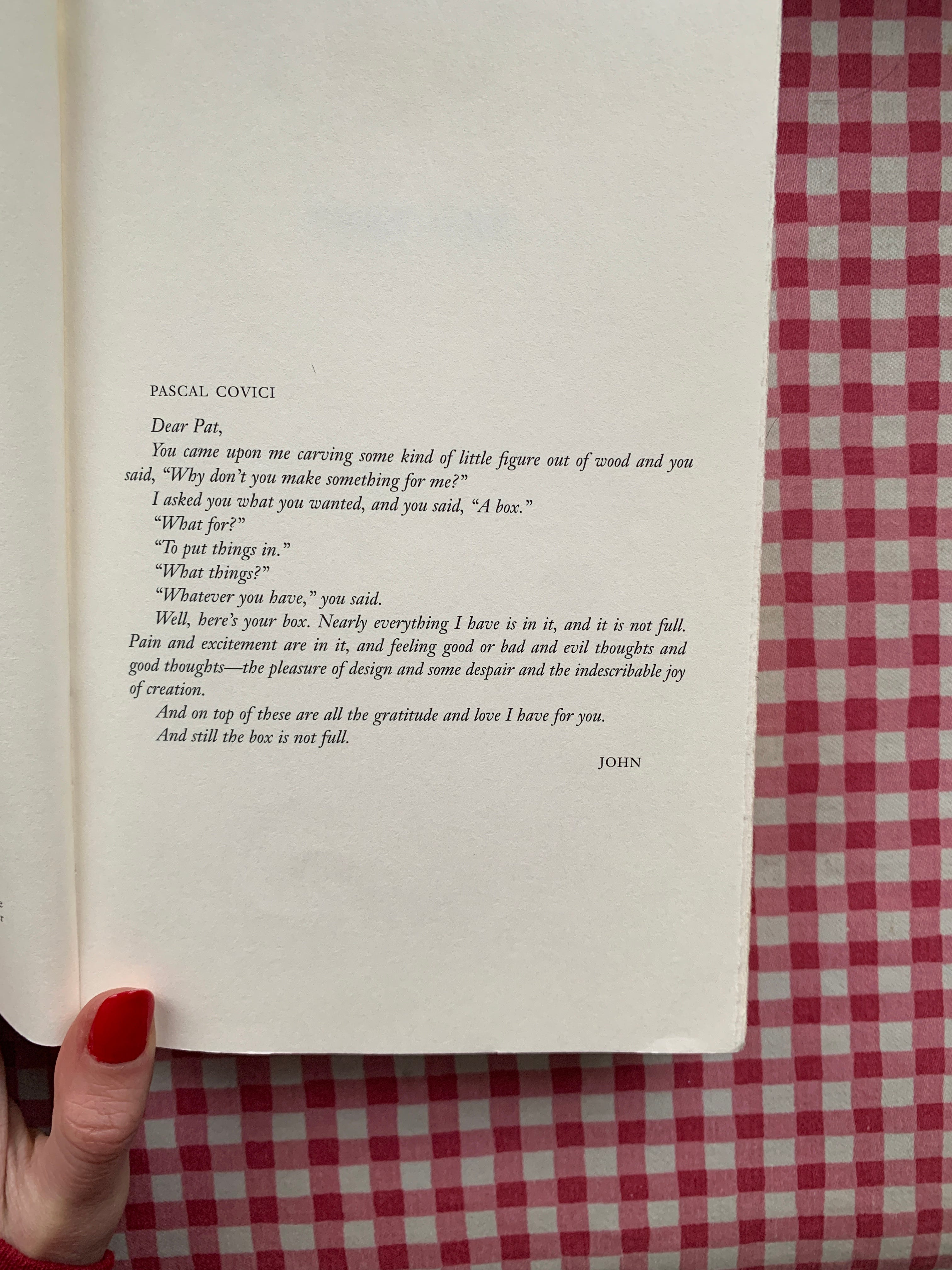
I first read of EoE 10 years ago; I can still remember the night I was staying at my grandparents’ house, sequestered away in the basement under a handmade quilt after 10 hours of Scrabble, reading into the early hours by the glow of my booklight, and the thrill that went through me when it finally started getting good. (Why do so many books need 10 chapters to get started? I know why, but why, you know?). Up to that point, I had been curious about the characters—particularly Cathy (she killed her parents! she was a sneaky diva! she was…the human stand-in for Evil Itself?!)—and where they might be going. Once they headed to California, I knew we were cooking with gas.
Unsurprisingly, the passage that struck me most that first time through was arguably its most famous, where Lee, Sam Hamilton, and Adam Trask discuss Genesis 4 and the story of Cain and Abel. It straight up includes the whole chapter of the Bible, a Hebrew lesson, and a philosophical discussion, and manages to not be pretentious or laborious in the process. This book is smart the way real people are smart. It isn’t trying to impress you; it’s not trying to teach you something or be profound, which, imho, is what makes it the Great American Novel. It draws you into the mystery, implicates you, excites you, but ultimately leaves it on you. Thou mayest. Even though I was in that feverish hurry to keep reading, that delicious delirium where what you’re reading feels like a cool glass of water on a hot summer night, I remember that I simply had to pause after reading that section, to pace, to think through its many implications, knowing that ultimately I couldn’t, but sensing I had been invited into a conversation that was open to me for the rest of my life, that I was passing from an old way of doing things into a new one, mysterious and saturated with depth and responsibility.
I remember being captivated by the Hamilton family the first time through, especially Tom, but sort of subconsciously categorizing them in my brain as merely an anecdotal foil to the Trask family, the prototypical “poor-but-happy-and-brilliant” to the ever-financially-lucky Trask clan despite the moral array within their ranks. Sam Hamilton reminded me of my grandfather, Liza of my grandmother, and the chapters where Sam talks philosophy with Lee and Adam or when he delivers Caleb and Aron and reads Cathy for who she is were the moments that most stuck out to me, yet I still considered the “most important” aspect/theme of the book to be the Trask family and their various choices across the Thou Mayest spectrum. I love the scene when Cal goes to visit Cathy at her brothel and realizes that though he is like her, he can choose whether or not he is like her. I was most affected by Cal, even though in many ways his character is somewhat underwritten, a stand-in for Cain, marked by some primal wrongness, who learns that “now that [he] doesn’t have to be perfect, he can be good.” He walked through the fire of his life, mistake after mistake after mistake; I wept both this time and then at the ending, seeing him come out the other side of it on the book’s final page.
But I really think it’s Tom Hamilton that’s the most well-written, and certainly the hardest to ultimately read. I remember having a literary crush on him when I read the book the first time, as his qualities that drew me in then are the same as those that draw me in now: brilliant, mercurial, one-of-a-kind, marching to the beat of his own drum regardless of what his peers are up to. And even amidst Adam’s cruel betrayal from Cathy (did not remember that she shot him!), Lee’s forgoing of a life of his own for a life of service, Aron’s untimely and unnecessary death, Cal’s longing for a blessing that will never be given, it’s Tom’s story that’s the true heartbreak of the book. Tom is the only character who can never really decide, which really is the ultimate tragedy in any life: having every gift and potential to be and choose something great, brave, gallant, original, and never ultimately being able to make any choice at all. He remains at war with himself, his nature, his purpose his whole life, and it ends up being a war in which he is the only casualty.
I’m up against a big choice in my life at the moment, one that feels like a great big door opening. And I don’t think I’ve ever been more aware that with every door that opens, another one is shut. I think, in any life, to really live, we have to choose. And the great difficulty in saying yes to anything is that it means you’re saying no to something else. I don’t think our greatest novels are meant to leave us with tidy lessons or specific conclusions to draw—we’re constantly projecting our own lives onto any narrative we consume and gleaning meaning accordingly, as even this essay is evidence of—but for me, that’s EoE’s most important lesson: to not make a choice is the greatest tragedy of all.
A line from my favorite musical, Sunday in the Park with George, comes to mind from that most gutting of final numbers, “Move On”: I chose and my world was shaken / so what? / the choice may have been mistaken / the choosing was not. I have a lump in my throat even writing it! Why must all great wisdom be hard won?
I felt truly awed and humbled reading that passage in the book between Lee and Adam and Sam. You know when you overhear a juicy, fabulous conversation on a plane? I felt genuinely lucky to read this conversation, despite me being so familiar with it, despite it having been turned over and over again in my head for the last decade. It’s the literal blood and guts of human life! It is life-changing, simple, impossible to do, yet we all have the option to do it. To choose. To dare, to decide, to gloriously and hideously flop. I’m crying again! I cannot believe we all have that option, no matter who we are, no matter how hard it is or whether or not anyone agrees with what we choose. It’s so much easier not to choose, to wait for something to happen and allow Fate to take over, to sit back passively and wait for what might happen to be spared the agony of knowing one way or another—and thus, potentially choosing the wrong thing, the thing that will cut us off from the life we dream of, from what we know is for us but are unsure of how to claim.
It’s a really sobering responsibility, something that sits so differently with me now than it did before. That’s one of my favorite things about getting older: revisiting totems that have lodged their way into my spirit over the years, and finding them still glowing with meaning—typically one I couldn’t recognize the first time around, or perhaps just wasn’t ready for. I love getting to come back with a new set of eyes, informed by what I’ve seen since then.
I’ve also recently been rewatching movies that absolutely dazzled me the first time I saw them. One such example is Looper; I’ll never forget seeing it at my beloved Regal UA Galaxy with a few of my best friends and my mom. We all sat in the theater for over an hour afterward, talking about what we’d just seen, what we would have done in each character’s situation. It was one of those conversations as alive as Thou Mayest, where we felt like we were discovering and dissecting a great truth that had been waiting for us. The concessions guy came in to clean up and ended up joining us. We were eventually kicked out by the manager because he had to go home.
Having rewatched Looper, I was less bowled over, largely because now I see pretty significant script errors and because I’ve seen so many movies since, and, surely, because I’m just older now. But it still, however many years later, feels incredibly original and deeply felt (the scene where Paul Dano’s face goes missing as he races against the future while he is tortured in the past will forever be a Top 10 Movie Moment for me), in a way that so little does now, at least to me. It was a massive swing, reckoning with a genuine, captivating moral question about good and evil. I was gobsmacked, marked by it. I remember feeling that way so often, going to movies every week with my friends and leaving the theater stunned, changed by what we’d seen (2014 and 2015 were absolute bangers across the board), babbling until 2am about life and perception and choice and integrity and what our responsibilities were in the face of their many intersections.
What was the last movie, book, idea, song, moment, that truly bowled you over? That felt like it was reckoning with the essence of your very life, the mystery of existence? I know growing older inures us to all kinds of wonder—and that youth is full of that greatest resource, time—but isn’t what that what great art is for? I won’t get on my soapbox about the state of the movie industry (yet!), but I want to retune my brain to that frequency, to keep my permeability high (low?), and to do my part to keep the torch burning that I’m responsible for carrying. I’m not much for New Year’s resolutions (“although of course you end up becoming yourself,” baby!), but this is the thought on the forefront of my mind as I cold plunge my way into this year: I want to continue to be permeable. It’s so easy to become callous, it’s embarrassing to be tender and earnest and sincere. “It’s so easy to laugh, it’s so easy to hate, it takes guts to be gentle and kind.” But, like, what else is there?
It’s a lifelong choice to keep showing up, to stay open to the Great Conversation we are all invited into, and it’s the question that has been at the center of my life for as long as I can remember (my queen Julien Baker says it so plain: When I could spend the weekend out on a bender / do I get callous or do I stay tender?). It’s a costly one, a lonely one, one that often has no discernible reward, and it’s so hard to stay interested in it as we get older, as we have more and more evidence to remain callous, uninterested, insincere, guarded, as we are less and less bowled over by the great happening illimitably earth. The Hamiltons were broke the whole book; the Trasks had outrageous tragedy follow each outrageous fortune. Everyone gets old. All we have are our choices, those that build on top of one another, and those that leave behind them closed doors as the result of one opened. I hope I continue to choose; and, if the choice be mistaken, the choosing is not.
Would love to know any works of art that have at any time bowled you over, brought you into the Great Conversation of Life, or rendered you gouged with sincerity like a freshman in a Lit 101 college course.
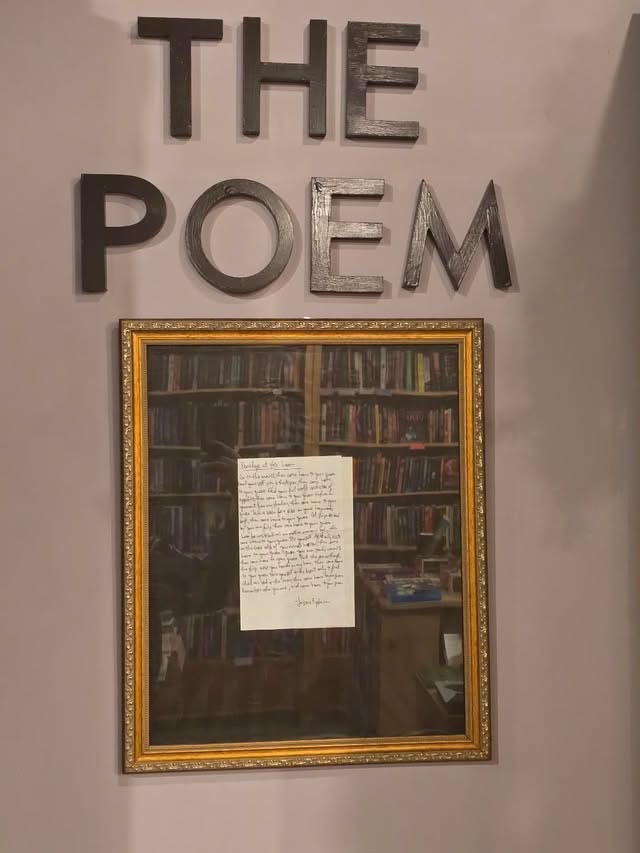
In my continued effort to share writing-related wins on this, my cherished Substack, my favorite hometown independent bookstore has had one of my poems on display for the past month; it makes me feel bashful, proud, and strong.
So much here that’s gold, Jess. Gold.
You will be UNSURPRISED to learn to EoE is my favorite novel. In college I wrote a paper interpreting it through John Donne's "No Man is an Island" meditation, which is a move I STAND BY. It's probably for the best that it has since been lost, but at the time I was euphorically high on the human experience, indeed gauged with sincerity! It is SUCH a book to read when you are considering your place in the world, oof.
PS. I have a thou mayest tattoo. Proof that for as long as I can remember, I knew I wanted to be an insufferable substacker. <3